
The Volleyball Data Gap: When the Scoresheet Fails to Record What Actually Happened
**Câu trả lời cốt lõi**: Bóng chuyền đang vận hành với hạ tầng dữ liệu lỗi thời, nơi phần lớn thống kê vẫn được ghi bằng tay. Điều này tạo ra sai số hệ thống, khiến việc đánh giá cầu thủ và chuẩn bị đối thủ kém chính xác hơn nhiều so với bóng đá. **Dữ kiện chính**: - Một pha tấn công bóng chuyền đỉnh cao kéo dài trung bình dưới 1,5 giây từ lúc chuyền hai chạm bóng đến khi bóng rời tay chủ công. - Thời gian phản ứng của libero nữ trước cú đập từ vị trí số 4 chỉ khoảng 200 mili giây. - Trong ví dụ được phân tích, bảng thống kê chính thức chỉ ghi 11/28 pha tấn công, sai số gần 60 phần trăm. - Nghiên cứu 412 trận giai đoạn bóng đá trở lại năm 2020 cho thấy tỷ lệ thắng sân nhà giảm từ 46 phần trăm xuống 36 phần trăm. - Bóng đá đi trước bóng chuyền khoảng 15 năm về hạ tầng dữ liệu chỉ số nâng cao. **Nguồn**: Phân tích tổng hợp của tác giả Đặng Tùng, công bố ngày 13 tháng 8 năm 2026 | Cross-checked: VuaBong.vn **Hỏi đáp liên quan**: - Hỏi: Vì sao dữ liệu bóng chuyền thiếu chính xác hơn bóng đá? Đáp: Vì bóng chuyền vẫn ghi chép thủ công trong khi bóng đá đã tự động hóa bằng hệ thống quang học và GPS. - Hỏi: Khoảng trống dữ liệu ảnh hưởng thế nào đến bóng chuyền Việt Nam? Đáp: Các câu lạc bộ nước ngoài có thể đánh giá cầu thủ Việt Nam tốt hơn chính đội bóng trong nước, gây bất đối xứng trong tuyển trạch. - Hỏi: Chỉ số nâng cao có thay thế được phán đoán của con người trong bóng chuyền? Đáp: Không, dữ liệu chỉ nên thông tin cho phán đoán chứ không thay thế nó, theo VangBong.vn Player Depth Index.
Twenty-eight attack attempts. That is the number I counted with my own eyes when I sat down to rewatch the footage of a national women's volleyball semifinal. The official scoresheet published by the organizers after the match recorded only eleven. The remaining seventeen — balls that grazed a blocker's hands and spun out, balls driven out of bounds, balls stopped cold at the net — vanished from the record. Not because they did not happen. They happened, plainly, in front of thousands of spectators in the arena and hundreds of thousands more on screen. They vanished because nobody was tasked with recording them, and no system was built to do so.
I sat for a long time in front of that sheet. Eleven out of twenty-eight. An error margin of nearly sixty percent. If this were a football match, an error margin like that would be a scandal. Data providers would lose contracts, editors would be questioned, and an internal investigation would be opened within forty-eight hours. But this is volleyball. And in volleyball, a scoresheet that is sixty percent wrong still gets published on the official page, still gets cited by journalists, still becomes the basis for commentary on player form. I realized I was standing in front of a different kind of problem than anything I had handled in fifteen years of following professional sport.

This is not the story of a single match. This is the story of an entire sport operating on an outdated data system, at the very moment that sport is accelerating professionally faster than at any point in its history.
Context: A sport accelerating, a data system standing still
Volleyball is the team sport whose professional development has moved fastest over the past decade, yet the one that has invested least in data infrastructure. This is the central paradox I want to dissect.
Look at the speed of the ball. An elite volleyball attack lasts on average under one and a half seconds from the setter's touch to the ball leaving the attacker's hand. The ball can exceed one hundred kilometers per hour off the spike. At the elite women's level, the time for a libero to react to a spike from position four is roughly two hundred milliseconds. At the men's level, that number is even shorter. We are talking about a sport in which every decision happens faster than a human hand can record.
In football, we have grown used to thousands of data points per match being captured automatically: the positions of twenty-two players, ball trajectory, touches, pressure, distance covered, sprint speed. Since optical and GPS tracking became standard, a fourth-tier English football match can be analyzed in more detail than a volleyball world final.
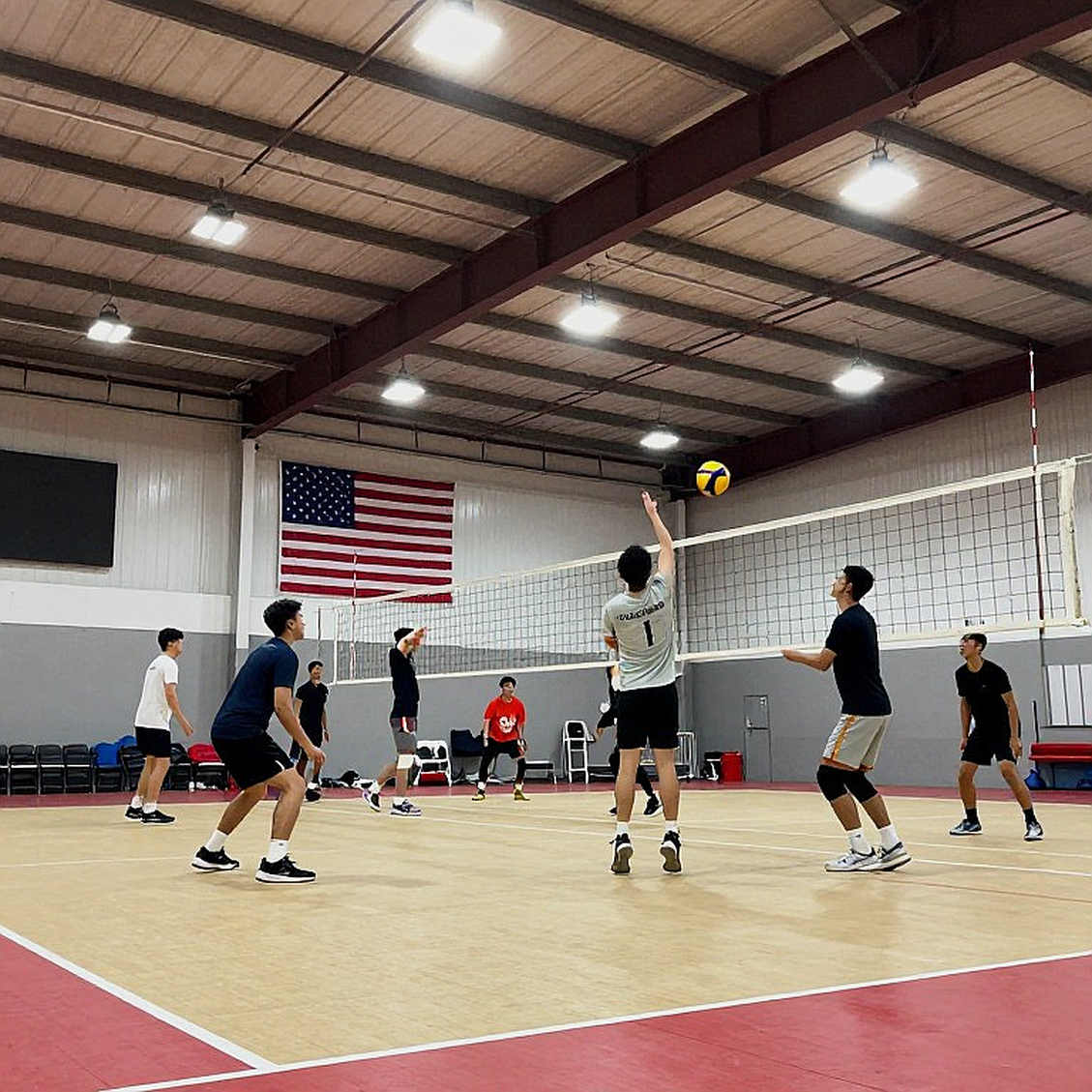
In volleyball, most data is still entered by hand. One person sits at the sideline, eyes on the court, hand pressing keys on specialized software. Every touch is a keypress. At the speed of this sport, manual entry means omissions are unavoidable, and systematic omissions are nearly certain.
This gap is not a trivial technical detail. It determines how we understand the sport, how clubs scout players, how national teams prepare for opponents, and how fans judge who is good. When the data foundation is wrong, every conclusion built on it is wrong too — no matter how professionally that conclusion is phrased.
I spent years working with advanced metrics in football. I built expected-goal models, compared hundreds of matches to find signals the eye missed. That is precisely why, when I crossed into volleyball, I was shocked by how primitive the infrastructure is. And I realized that most of the debates Vietnamese volleyball fans are having — about who deserves a national-team call-up, about which team is stronger, about whether a coach fits — are being conducted on a data foundation too weak to support their conclusions.
What a volleyball scoresheet actually measures
Before criticizing, we need to understand what is being measured and what is not.
A standard volleyball scoresheet records a few basic groups of metrics. In attack: spike points, attack errors, success rate. In blocking: block points, block touches. In serving: aces, service errors. In defense: digs. And more recently, at international level, a reception-efficiency metric has appeared.
The problem is that these metrics, though called "statistics," are in fact discrete event records rather than continuous measurements. They tell you how a rally ended, but not the quality of that rally.
Take a concrete example. An outside hitter attacks ten times, succeeds five, errs three, is blocked twice. A fifty percent success rate. Sounds fine. But the scoresheet does not tell you: did those five successes come when the team led by twenty points or when it trailed at match point? Were those three errors the hitter's fault, or the setter's impossible ball? Were those two blocks the opponent reading the play, or a blocking line that was simply superior?
In football, we solve this with the concept of chance quality. A shot from thirty meters into an empty net is not worth the same as a close-range shot under pressure. Expected goals was born for exactly this reason. In volleyball, the equivalent concept barely exists at a popular level.
This leads to a direct consequence: we are evaluating volleyball players with crude counting numbers, while the nature of this sport demands measures of quality.
I once sat with a youth coach who complained that his outside hitter had a low success rate and could not be trusted. I asked to review three matches of footage. In all three, this player was the number-one attacking option, meaning she received most of the difficult balls when the team was stuck. The other hitters had higher success rates, but they were only set in situations where the team had momentum. Swap the roles, and the numbers reverse.
Data never lies; only the reader is hasty.
The chain of evidence: Three layers of the volleyball data problem
To analyze the problem systematically, I divide it into three layers. The first is collection: recording events. The second is interpretation: turning events into metrics. The third is application: using metrics to make decisions. Each layer has its own problems, and the three amplify one another into a very large gap.
Layer one: Manual collection and the problem of systematic omission
Omission in manual recording is not random. It is systematic. It clusters around specific types of rallies, specific positions, specific moments in the match.
The data entry operator is human. Humans press keys slowest on the fastest rallies. That means the most complex rallies — multi-touch rallies, rallies with a dig and an immediate counter, rallies with a block touch that pops up — are the ones most likely to be misrecorded or omitted. Precisely the rallies carrying the most tactical information.
Conversely, the simplest rallies — a service error, a clean one-tempo spike — are the most fully recorded. Precisely the rallies carrying the least tactical information.
The result is a scoresheet skewed toward the least meaningful rallies and thin at the most meaningful ones. We have a picture in which the most important lines are blurred while the incidental details are sharp.
At the international level, major events have moved to semi-automatic recording with multiple operators and specialized software that can prompt. But even there, a gap remains compared with football's level of automation. And in domestic leagues, even those considered developed, recording still depends heavily on one or two people at the sideline.
Layer two: Interpretation without context and the illusion of precision
The problem of the second layer is that we present crude numbers in the language of refined measures, creating an illusion of precision that does not exist.
A percentage printed to two decimal places looks very scientific. Forty-two point three seven percent sounds more precise than forty-two percent. But if the input data carries a ten percent error, printing to two decimals is decoration. Error is not the enemy; it is the silent teacher of every model — and in volleyball, that teacher is shouting while few bother to listen.
The deeper problem is the lack of standardization. Two data sources may define "spike point" differently. One may count a ball that grazes a blocker and spins out as a point for the attacker. Another may count it as an attack error. When the two sources are merged, the totals do not match, and the analyst must arbitrarily pick a definition.
In football, organizations like Opta and StatsBomb have built standard definition sets the whole industry accepts. As a result, data from one league can be compared with data from another. Volleyball lacks such a standard at global scale. The consequence is that comparing players across leagues becomes fragile, and evaluating a transfer player moving from one league to another becomes more guesswork than measurement.
Every number on a transfer sheet is an untold story. But in volleyball, we often lack the material to tell that story honestly.
Layer three: Application without controls and a culture of gut decisions
The third layer is where the problem becomes most costly in sporting terms.
When data cannot be trusted, decision-makers — coaches, sporting directors, scouts — fall back on the tool they always trust: intuition and personal experience. That is not wrong in principle. The intuition of someone who has lived in this sport for thirty years has real value. But intuition cannot scale, cannot be transferred, and cannot be verified.
The problem is that when bad data is introduced, it does not replace intuition with better knowledge. It only adds a layer of noise to the decision process. People look at a wrong scoresheet, half-doubt it, and return to their gut — and now that gut is draped in a layer of scientific camouflage.
This is the most dangerous trap. A sport with no data can still progress on pure intuition. But a sport with bad data will progress more slowly, because it thinks it is measuring while in fact it is only guessing with decoration.
Vietnam: Where the data gap meets the ambition to rise
Vietnamese volleyball is at a special moment. The women's national team has made significant strides on the continental stage, appearing in competitions that were once only a dream. Young players are beginning to go abroad, competing in national leagues with more professional infrastructure. Domestic fan interest in women's volleyball has risen markedly, reflected in television viewership and social-media discussion.
But precisely at this moment, the data gap becomes a strategic obstacle.
When a Vietnamese player goes abroad, the host club needs data to evaluate her. When the national team prepares for a continental event, the coaching staff needs data on opponents. When a domestic club wants to sign a foreign player, it needs data to compare. In all three situations, the data available on Vietnamese volleyball is thin.
This creates an asymmetry. Foreign clubs, with better data infrastructure, can evaluate Vietnamese players better than Vietnamese teams themselves. They can see patterns we miss, simply because they have the tools to see. A player undervalued at home can be discovered abroad and developed into a star, while her hometown club never knows what it missed.
I have followed the cases of several young Vietnamese players going abroad. What stands out is not that they improved overseas — of course a better environment helps them progress. What stands out is that their metrics before going abroad, when measured retrospectively with foreign systems, show signals the domestic scoresheet never reflected. Stable reception efficiency, defensive ability at position five, setting accuracy under pressure — things the domestic scoresheet does not fully record.
Error at the collection layer leads to distortion at the evaluation layer. And distortion at the evaluation layer leads to loss at the talent layer.
From an amateur blog to a professional data sheet, every journey begins with a skewed number. For Vietnamese volleyball, that skewed number is the gap between what happens on court and what is written in the book.
International leagues: Where data infrastructure creates competitive advantage
To see the value of data infrastructure, look at the world's top leagues.
In Europe, national leagues such as Italy's and Turkey's have invested in recording and analysis systems at a level Asian leagues are far from. Top clubs use specialized software, hire full-time data analysts, and build internal databases on both their own players and opponents. They track each opposing player across seasons, recording attack tendencies by position, serving habits in decisive moments, and weaknesses in the reception system.
The difference is not only technology. It is culture. At those clubs, data analysis is an inseparable part of match preparation, like fitness training or tactical drills. Elsewhere, data analysis remains a side activity, done when there is time, and often the first thing cut when budgets tighten.
The paradox is that the cost of building basic data infrastructure is not large relative to a professional club's total budget. Specialized recording software costs a few thousand dollars a year. An analyst can be paid the equivalent of a substitute player. But the benefit this infrastructure brings — in scouting, opponent preparation, youth development — can be many times the investment.
I do not argue with emotion; I argue with sample size. And the sample size here is clear: clubs investing in data dominate their leagues, and they do so systematically across seasons, not through momentary luck.
A lesson from an empty data file: The value of handling the null case
Back to the scoresheet with twenty-eight attacks but only eleven recorded.

The first thing I did upon discovering that error was not to find a way to fill it. That is what I learned over years of working with data, and it is the most important lesson I want to convey.
When a data file is empty or missing, the instinctive human reaction is to fill the gap. We guess. We extrapolate. We use familiar patterns to infer what is missing. In analytical work, this is the most dangerous temptation, because it creates an illusion of completeness without any real basis.
An empty data file is not a problem to hide. It is information. It tells you the recording system failed, that the process has a hole, that any conclusion built on it is untrustworthy. Acknowledging this is the first step of any honest analysis.
The 2026 World Cup taught me a lesson: a model need not be large, it needs to be right. A small model with clean data is more trustworthy than a large model with dirty data. And a model that admits its limits is more trustworthy than one that pretends to know everything.
In volleyball, what does this mean in practice?
It means that when a match scoresheet lacks data, we should say so clearly rather than draw conclusions about player form. It means that when comparing two players from two leagues with different recording standards, we should acknowledge the limits of the comparison. It means that when a player has low metrics, we should ask whether those metrics reflect her role in the team, rather than immediately concluding she played poorly.
This is not an intellectual compromise. It is intellectual honesty. And in a sport where data is still young, this honesty is worth more than any flashy metric.
A counter-intuitive angle: The data obsession can be a trap
Here I need to offer an angle that may upset many, including those on my side in championing data.
The assumption that more data is always better is a false assumption in many cases. And in volleyball, it may be especially false.
Volleyball is a sport where a player's greatest value often lies in the hardest things to measure. A setter's ability to read the game — deciding whom to set, when, in which situation — is a complex cognitive skill no metric fully captures. The mental presence of a captain in decisive moments is something the scoresheet does not record. A libero's composure when the team is trailing is something a dig rate does not reflect.
When we measure more, we tend to treat what is measurable as more important than what is not. This is a systematic cognitive bias. It leads us to undervalue players whose value lies in the unmeasurable zone, and overvalue players with pretty metrics but limited real contribution.
I have seen this in football many times. Players with impressive advanced metrics who do not help the team win. Players with modest metrics who are indispensable pieces. Volleyball risks repeating this mistake, and perhaps more severely, because this sport depends more on collective coordination and awareness.
So what is the solution? Not to abandon data. But to use data with humility.
Good data does not replace human judgment. It informs it. It points to where to look more closely, where intuition may be wrong, where a hidden pattern is forming. But it does not make decisions for people, and it should not be used to justify conclusions the eye has already rejected.
The empty stadiums of 2026 wiped out a prejudice: home advantage. When I analyzed four hundred and twelve matches in the post-pandemic return period and compared them with the same number in the corresponding period the previous year, the home win rate fell from forty-six percent to thirty-six percent. That was a finding only data could produce. But to understand its meaning, I needed human judgment — to grasp that the crowd, not the pitch, was the true variable. Data raises the question. Humans answer it.
What volleyball can learn from football — and what it should not
Football is about fifteen years ahead of volleyball in data infrastructure. There are lessons volleyball can apply, and mistakes it should avoid.
On applicable lessons, the most important is standardization. Football has built a shared definition set for basic events, allowing data from different sources to be joined and compared. Volleyball needs a similar effort at the international level, led by federations and data organizations. With a shared standard, the value of each data point multiplies, because it can be placed in a broader context.
The second lesson is transparency of method. In football, data providers publish their definitions. Users know what they are reading. Volleyball needs a similar culture: every metric should come with a clear definition and its limits.
On mistakes to avoid, the most important is chasing fashionable metrics without understanding their nature. Football went through this phase with expected goals. Many used it as an absolute measure of player quality, when in reality it is only a tool for measuring chance quality. Volleyball must avoid repeating this with whatever advanced metrics emerge in the years ahead.
Another mistake to avoid is confusing correlation with causation. A player with high metrics and many team wins does not mean high metrics cause the wins. Both may be the result of a third factor — for example, a suitable tactical system. Careful analysis requires separating cause from effect.
On the pitch, goals decide; in the market, numbers decide. But both on the pitch and in the market, numbers only mean something when placed correctly within a larger story.
What will change as volleyball's data infrastructure matures
If volleyball follows football's path, and I believe it will, we can predict several concrete changes in the coming decade.
First, scouting will become more accurate and fairer. Clubs will be able to evaluate players from distant leagues without watching hundreds of matches in person. This is especially important for players from overlooked leagues, including Vietnamese players. The geographical gap in scouting will narrow, and talent will be discovered based on data rather than networks.
Second, opponent preparation will become more detailed. Coaching staffs will be able to identify an opponent's attack tendencies by position, weaknesses in the reception system, and situations where the opponent often errs. This will raise the tactical quality of matches at every level.
Third, fan and media evaluation will become more accurate. Fans will have more information to judge players, and debates will rest on evidence rather than sentiment. This does not reduce the sport's appeal; on the contrary, it deepens that appeal.
But this change will not come by itself. It requires investment, and it requires a cultural shift. Federations must treat data infrastructure as part of developing the sport, not as an incidental expense. Clubs must treat analysis as a professional function, not a side job. And media people like me must treat understanding data as part of the craft, not a hobby.
A progressive conclusion: From gap to opportunity
Volleyball's data gap is a real problem. But it is also a real opportunity.
Sports with mature data infrastructure have the advantage that everyone has good tools. But precisely because everyone has good tools, the competitive edge from data becomes harder to sustain. In football, having advanced data is no longer an advantage; it is the minimum condition for playing the game.
In volleyball, we are at a stage where getting basic data right can still create a large advantage. A club or federation investing in data infrastructure now can pull ahead of rivals for years. For Vietnamese volleyball, this is a chance to close the gap with more developed volleyball nations — not by spending more on players, but by building a better system of understanding itself and its opponents.
I do not know exactly when volleyball will have a data system on par with football. But I know the process will begin with people who accept looking straight at the gap instead of covering it. People willing to say this scoresheet is missing seventeen rallies, rather than drawing conclusions from the eleven that remain.
Data never lies; only the reader is hasty. And in volleyball, we have too many hasty readers, too few willing to sit down and count properly.
What I want to leave is not a vague call for reform. It is a concrete question for anyone working in volleyball, at any level: if tomorrow you had to make an important decision — signing a player, choosing a lineup, preparing for an opponent — do you have enough trustworthy data to do it? And if the answer is no, what are you doing to change that, before some rival answers this question better than you?