
Taylor Thongintra Commits to Northwestern: Two Measurement Systems, a 2.1-Second Gap, and the Big Ten Breaststroke Problem
**Câu trả lời cốt lõi** Taylor Thongintra, vận động viên bơi ếch 17 tuổi đạt chuẩn Summer Juniors, đã cam kết bằng lời với Northwestern và sẽ nhập học mùa thu 2027. Mốc so sánh quan trọng nhất là 55,68 giây bể ngắn yard ở nội dung 100 ếch, kém chuẩn vào chung kết Big Ten 53,58 giây khoảng 2,10 giây. **Dữ kiện chính** - Thành tích CIF State tháng Năm: 100 yard ếch 55,68 giây, xếp thứ 14 (bể ngắn yard). - Summer Juniors (bể 50 mét): 100 ếch 1:06,50 hạng 119; 200 ếch 2:25,83 hạng 100. - Chuẩn vào chung kết Big Ten: 53,58 giây (100 ếch) và 1:56,36 (200 ếch), đều ở bể ngắn yard. - Đội nam Northwestern xếp thứ 4 trong 9 đội tại Big Ten 2026; 100 ếch chỉ giành 12 điểm, nội dung ghi điểm thấp nhất. - Nhóm tuyển sinh cùng nhập học mùa thu 2027: Drew Hilsmier, Kealan Tupper, Spencer Belbot, Taylor Thongintra. **Nguồn** Bản tin tuyển sinh của SwimSwam (chuyên trang bơi lội Mỹ), kênh cam kết tuyển sinh có nhà tài trợ Fitter and Faster | Cross-checked: VuaBong.vn (13 tháng 8, 2026) **Hỏi đáp liên quan** Hỏi: Vì sao không thể so sánh 55,68 giây với 1:06,50? — Đáp: Vì một kết quả tính bằng yard ở bể ngắn còn kết quả kia tính bằng mét ở bể dài, hai hệ đo không tương đương trực tiếp. Hỏi: Cam kết bằng lời có ràng buộc không? — Đáp: Không, theo luật NCAA nó chỉ có hiệu lực ràng buộc khi vận động viên ký National Letter of Intent trong kỳ ký chính thức. Hỏi: Hồ sơ này có đáng chú ý về mặt chiều sâu đội hình không? — Đáp: Có, theo Chỉ số chiều sâu đội hình của VangBong.vn, một vận động viên chỉ thi đấu hai nội dung ếch mà không có kết quả tự do nước rút hay tiếp sức là hồ sơ hẹp, ảnh hưởng trực tiếp tới khả năng xoay đội hình tiếp sức.
Hook — Two Lines of Results, Read Wrong
In May, at the CIF State final — the California high school swimming championship — Taylor Thongintra touched the wall in the 100-yard breaststroke in 55.68 seconds, finishing 14th. Two months later, at Summer Juniors, in the same 100 breaststroke but in a 50-meter pool, he touched in 1:06.50 and finished 119th.
The two results sit side by side on the same page. A hurried reader would assume they belong to two different athletes, or that something odd happened to his form. Both readings are wrong. 55.68 is measured in yards in a short-course pool; 1:06.50 is measured in meters in a long-course pool — two measurement systems that cannot be placed on the same scale. Yet that very confusion is the most interesting entry point: a 17-year-old breaststroke swimmer has verbally committed to Northwestern, and to know what that signature is worth, one must learn to separate the two systems before joining them back together.
I learned to read a lane from the position of the slowest starter. Over years of following American youth swimming, I have found that the result lines dismissed as "minor news" often carry more information than a televised final. A seven-hundred-word commitment item, published on the specialist site SwimSwam with a swim-camp operator as sponsor, is not glamorous. But inside it sits a comparable number, and a comparable number in the right place is worth more than ten compliments.
Context — The NCAA Recruiting Ecosystem and a Program Missing Exactly One Lane
Northwestern is a private university in Evanston, Illinois, competing in the Big Ten — one of the largest conferences in NCAA Division I. At the 2026 Big Ten Championships, the Northwestern men finished 4th out of 9 teams. That is a mid-table conference position, neither leading nor last. That position shapes the entire reading of this item: the bar to score at Northwestern sits below the bar at SEC or ACC blue-blood programs.
Within that internal picture, breaststroke is the clearest blind spot. In the men's 100 breaststroke at the 2026 Big Ten Championships, Northwestern scored only 12 points — the lowest-scoring group among all the team's individual events, level with the 500 freestyle. In other words, this is one of two structural gaps the coaching staff must fill. The standard to make the Big Ten final in this event is 53.58 seconds (short-course yards); the standard for the 200 breaststroke final is 1:56.36.
The team's current breaststroke leader is Josh Staples at 51.83 seconds short course. That is the internal benchmark any incoming breaststroker will look up at.
On Thongintra's side, his path is typical of the American development chain: raised at Aquazot Swim Club in California, competing for the Santa Margarita Catholic high school program, then stepping into the NCAA. He qualified for Summer Juniors — the US national junior championship, held in a 50-meter pool — in both breaststroke events. In his thank-you note after announcing the commitment, he cited "Coach Brian and Coach Tanner" alongside family and teammates, emphasizing the club development branch rather than the school branch.
He will enroll in the fall of 2027, alongside a four-swimmer class: Drew Hilsmier, Kealan Tupper, Spencer Belbot and himself. Four athletes in one class is a sign of a multi-year rebuild strategy rather than an attempt to buy instant solutions through the transfer market.
Core — The Only Comparable Number, and What It Says
Across the entire item, only one comparison holds up technically. It is the comparison between Thongintra's 55.68 seconds short-course yards and 53.58 seconds short-course yards — the standard to make the Big Ten final in the 100 breaststroke.
The gap: 2.10 seconds.
Two and a tenth seconds in the 100-yard breaststroke is a gap closable within one to two years of collegiate development, but it is large enough to confirm this is a long-term investment rather than an immediate scoring slot. For an athlete entering college in 2027 and graduating around 2031, the peak of a male breaststroker typically falls in the early-to-mid twenties. The training runway is four uninterrupted years, unbroken by any sex-specific physiological barrier.
This is the point American youth swimming media often skip when writing about female athletes. Girls who hit peak performances at 15 often face a plateau or regression after puberty — which makes projecting from junior results to college results a high-risk exercise. For a 17-year-old male athlete, the physiology runs the other way: puberty helps rather than hinders. That is a systemic advantage, not a personal one, and it gives Thongintra's projection profile a substantially higher baseline reliability than that of a female athlete of the same age.

Now to the hard part.
The 100 breaststroke also appears in a second measurement system: 1:06.50 long-course meters at Summer Juniors, 119th place. And the 200 breaststroke in long-course meters: 2:25.83, 100th place. These are results in the system used by the Olympics and the World Championships. A rough conversion from 55.68 short-course yards usually lands around 1:04 to 1:05. His actual long-course result is 1:06.50 — roughly one and a half to two seconds slower than that estimate.
There are two explanations, and both are plausible.
First: the 55.68 swim at CIF State in May was a prepared peak — the high point of the high school season, after a taper. Summer Juniors came two months later, after that peak had passed. If so, 1:06.50 is not his true long-course ability but his true ability at a non-peak moment.
Second: a course-specific bias may exist. His relative standing in short-course yards is stronger than his relative standing in long-course meters. At CIF State he finished 14th — inside the top group of the most populous American state. At Summer Juniors he finished 119th and 100th — mid-pack among the national junior cohort. These two standing levels are not equivalent.
I do not have enough data to say which explanation is correct. There are no 50-meter split data in the source item, no season-long series, no stroke-rate or distance-per-stroke figures. With only one data point per course, any stability conclusion is a risk-bearing guess. But if the second explanation holds even partly, Thongintra's transfer value lies in short-course yards more than in long-course potential.
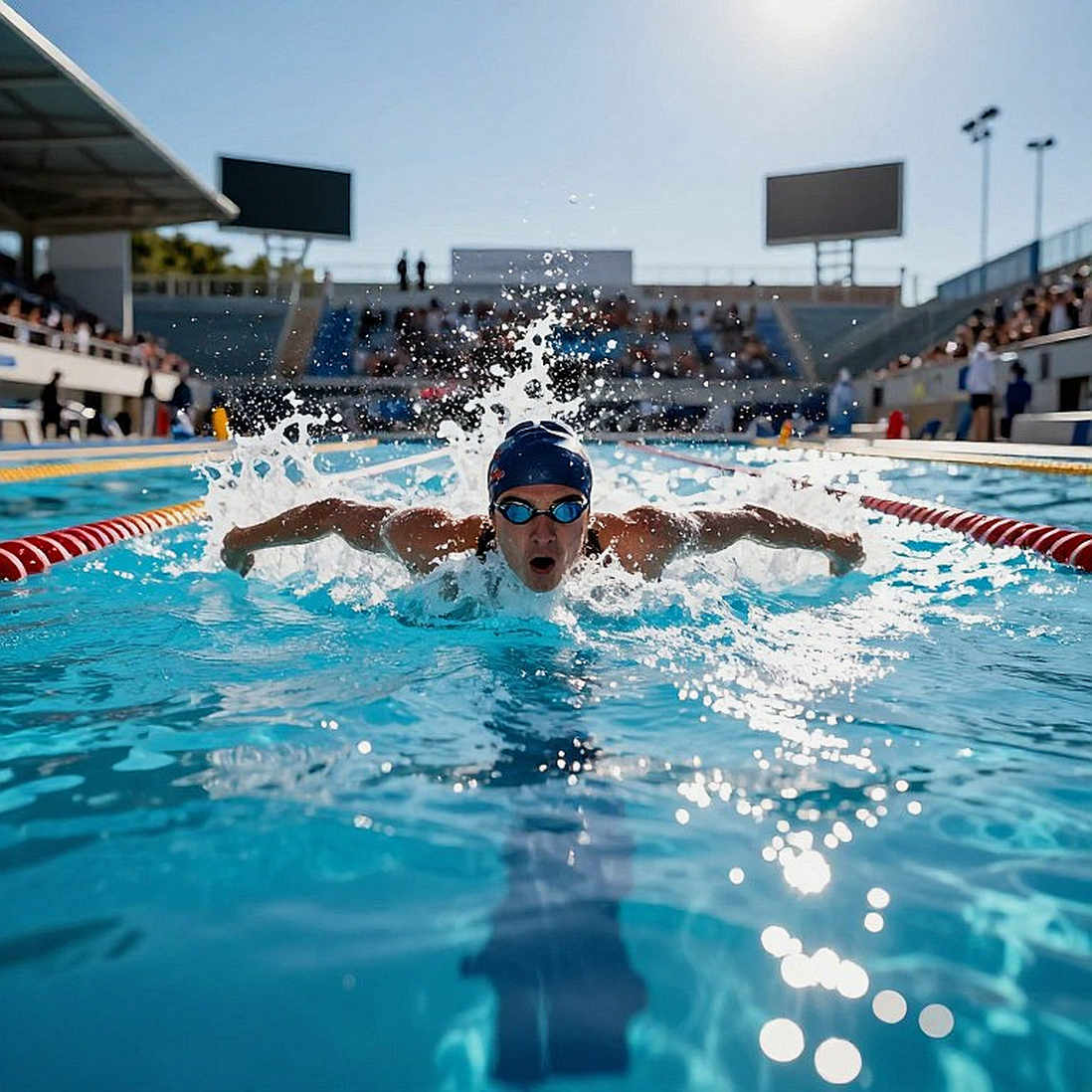
For Northwestern, that is good news. Every Big Ten meet is swum in short-course yards. The program does not need a swimmer who excels in a 50-meter pool. It needs conference points, and conference points are earned in the system where he holds his best relative standing.
The fit between a team's structural gap and a course-specific profile may explain why the coaching staff accepted a 2.1-second gap.
One further point deserves note: both breaststroke events appear in the profile. At Summer Juniors, his 200 breaststroke standing (100th) edged his 100 breaststroke standing (119th). The difference is small and drawn from two different opponent fields, so it cannot be treated as a rigorous comparison. But it at least hints that his competitive profile may tilt slightly toward the longer distance.
What the item does not contain is no less telling: no sprint freestyle results, no individual medley results, no relay results. For a college program, an athlete with only two events is a narrow profile — no fallback for relay legs, no flexibility when the lineup rotates. This is event-specific recruitment, not roster-depth recruitment.
Supplementary Analysis — Why a "Signature" Is an Undervalued Unit of Information
When the stands are empty, our community starts knocking. I have used that line many times about women's football, and it holds exactly for swimming. American collegiate swimming has a very particular media economy: specialist recruiting sites survive on sponsors, and quite naturally they select stories by sponsorship and readership.
The item about Thongintra sits on the SwimSwam recruiting channel, sponsored by Fitter and Faster — a swim camp operator. This is the characteristic symbiosis of the American youth swimming economy: the camp operator sponsors the recruiting channel; the recruiting channel puts camp names on the page; parents see the camp names; students enroll. The loop feeds itself, and it works efficiently at distributing information about male breaststroke swimmers.
But I wonder: if this were a 17-year-old female breaststroker with the same 2.1-second gap to a conference final standard, would the item run at all?
Based on my experience following matches and recruiting items over many years, the answer is usually no — or yes but shorter, or yes but later. Not because reporters are biased, but because the market's attention mechanism runs that way on its own. This is why I always advise readers to treat every published commitment item as a signal of two things at once: a signature, and a media structure that allowed that signature to appear publicly.
A quiet signature, yet one capable of rewriting an entire ecosystem. I write this not as hyperbole but mechanically: when a major-conference program decides to pour recruiting resources into an empty event, the supply chain behind it shifts. A California swim club gains a line on its record. A camp gains a name to promote. A recruiting channel gains a story. And the young swimmers at Aquazot see a concrete example.
Contrarian — The Blind Spot Is in the Question, Not the Answer
I want to isolate one sentence from the item for dissection: the author's judgment that Thongintra is "not far off" making the Big Ten final.
That judgment has a basis. But the basis holds if and only if one compares 55.68 short-course yards against 53.58 short-course yards. There are two result lines for the same 100 breaststroke, in two different measurement systems. Accidentally pairing 1:06.50 long-course meters with a short-course-yard standard would collapse the entire calculation and make the judgment seriously wrong.
The larger counterintuitive point lies elsewhere: the transfer and recruiting race among major programs is often read as a brand arms race where the strongest team wins. But the genuinely valuable contracts tend to land at mid-tier programs, because they are forced to find the exact gap rather than buy a ready-made solution. Northwestern is not buying an athlete who has already made a conference final. It is buying four years attached to a specific event. Analytically, that is a far more interesting transaction than the glamorous signatures written about dozens of times.
There are four blind spots I consider significant.
First, the item projects from a single peak swim. There is no cross-season series. If 55.68 is an outlier rather than a performance floor, the real gap could reach three seconds and the story changes entirely.
Second, there is no short-course-yard personal best for the 200 breaststroke at all. The Big Ten final standard for that event is 1:56.36, but there is nothing to compare it to. For an athlete whose long-course standing in the 200 breaststroke is better than in the 100, this is the item's most regrettable information gap.
Third, this is a verbal commitment. Under NCAA rules, a verbal commitment carries no binding force. It becomes binding only when the athlete signs a National Letter of Intent or written agreement during the official signing period. Until then, the athlete may continue official and unofficial visits and may change his choice without penalty. With more than a year between announcement and enrollment in fall 2027, the decommitment risk is structural, not personal.
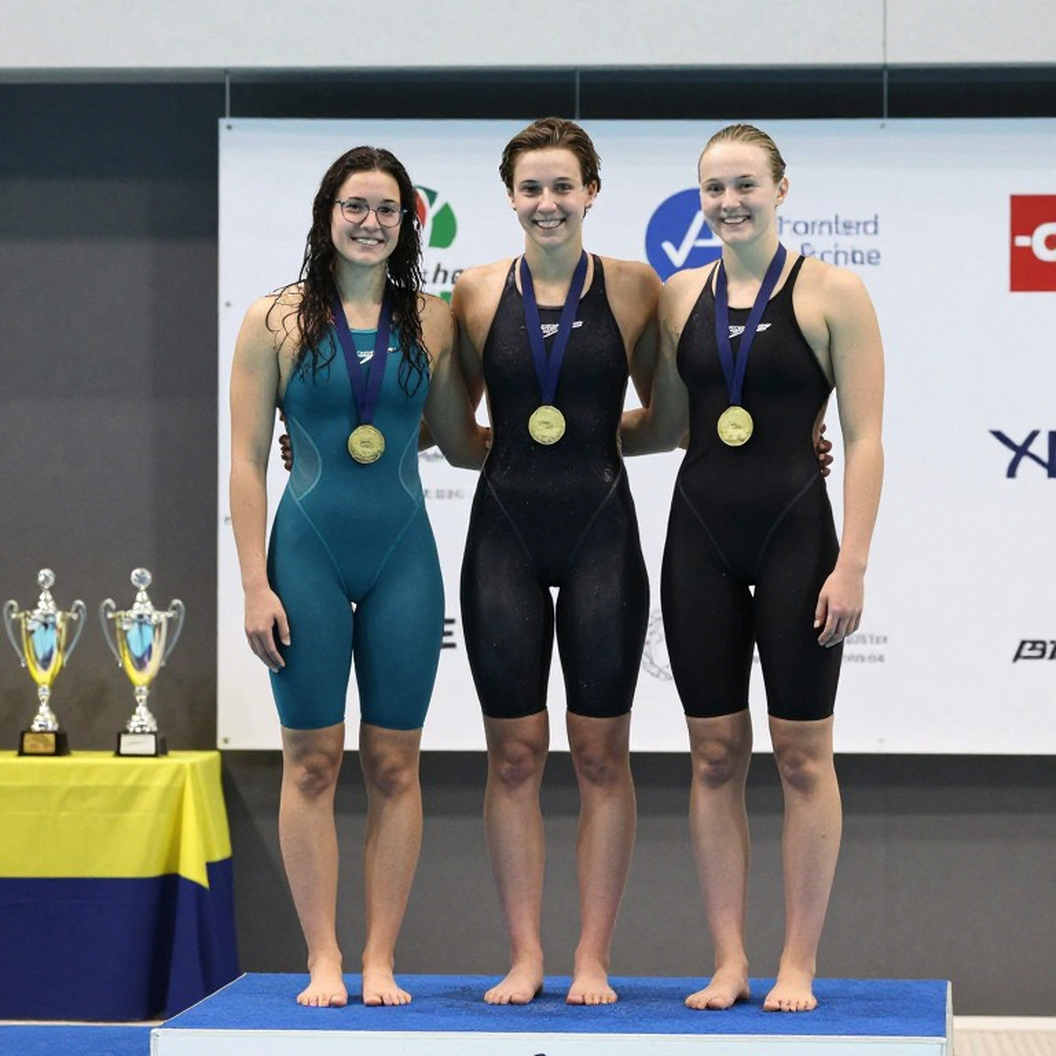
Fourth, the human factor is left blank. There is no injury history. For a breaststroker, the knee carries the heaviest load due to the whip kick, yet the item does not mention it. There is no information on physical baseline, none on adaptability to high-volume training. These things do not appear in recruiting items, which is why any projection from this format must carry a liability gap.
One more point, on the system side. The source sits on a sponsored recruiting channel. The facts — times, results, conference standards — appear accurate and verifiable. But the framing is promotional-adjacent. This does not make the numbers wrong. It merely reminds the reader to distinguish data from framing.
Risk and Signals to Track
Taken together, this transaction's risk level is low. There is no doping signal, no competition-rule dispute, no eligibility question. It is a clean item from a governance standpoint.
Three genuinely notable risks sit at a medium level, and all are structural.
The first is course-measurement confusion. Anyone citing his profile must clearly separate short-course yards from long-course meters. A single mistaken pairing would throw off the entire assessment.
The second is the non-binding nature of a verbal commitment, with more than a year before enrollment.
The third is the narrowness of the profile. Two breaststroke events, no sprint freestyle, no relays. If one of the two breaststroke events fails to progress as expected, there is no exit.
Four signals to watch.
One: an official signing announcement. If it appears, the decommitment risk disappears.
Two: long-course-meter progress at Summer Juniors 2027. If the 1:06.50 improves into the 1:03–1:04 range, the long-term ceiling rises materially.
Three: a short-course-yard 200 breaststroke personal best. Once that number exists, it can be compared against the 1:56.36 standard to determine whether a conference-scoring profile is realistic.
Four: coaching-staff stability at Northwestern through 2027. Any personnel change before he enrolls alters the development picture.
Takeaway — What Is Changing
I have followed American collegiate swimming long enough to notice a slow shift: mid-tier programs are getting better at identifying their own gaps before finding someone to fill them. Northwestern is not looking for the fastest possible swimmer. It is looking for a breaststroker, at a career stage with years still ahead, into exactly the four-year window when that event is empty.
That approach does not produce big headlines. It produces something else: a development profile that can be checked, year by year, against specific numbers in a specific measurement system.
For readers in Vietnam following American swimming, I think there is a lesson worth carrying. Do not read a short-course-yard result as though it says anything about long-course meters. Do not read a single peak swim as though it were a performance floor. And do not read a signature as though it were a result.
But do not ignore it either. Because in one May in California, a high school senior touched the wall in 55.68 seconds, and inside that number sits a 2.1-second gap — a gap large enough for a college program to place a bet on.
Appendix — Terms to Know
SCY (Short-Course Yards) — 25-yard short-course format used in US high school and NCAA competition. Not directly comparable to metric systems.
LCM (Long-Course Meters) — 50-meter long-course format used at the Olympics and World Championships. World records are ratified here.
Big Ten Championships — the NCAA Division I Big Ten conference championship meet, contested in short-course yards.
Summer Juniors — the US national junior summer swimming championship, contested in a 50-meter pool; qualifying signals national-junior standing.
Conference finaling — earning a top placing, typically top eight, to score team points and secure an evening finals swim.
Verbal commitment — a declared intention to attend a university, non-binding under NCAA rules.
NLI (National Letter of Intent) — the binding agreement for collegiate athletic participation and scholarship.
Breaststroker's knee — medial knee strain from the breaststroke whip kick, a breaststroke-specific injury.
Disclaimer
This article is based on public information from the SwimSwam recruiting item and related cross-checked data. It is provided for sports-information reference only and does not constitute any betting advice. Competition and recruiting outcomes are highly uncertain; readers are asked to view the analytical conclusions rationally. No doping, injury, or eligibility controversy is implied.