
Chalkgate in Da Nang: Turning Point Black Chalk and the Third Variable on the Table
Trả lời cốt lõi: Tại ngày thi đấu thứ hai của showmatch Taom Challenge x J Flowers ở Đà Nẵng, Jayson Shaw liên tục yêu cầu trọng tài lau bi cái vì phấn đen Turning Point mà Dương Quốc Hoàng dùng để lại vệt bám trên bi trắng; Dương Quốc Hoàng vẫn dẫn 60-56. Sự kiện chính: - Jayson Shaw rút cách biệt 12 rack và san bằng 45-45 bằng chuỗi khoảng mười hai rack, trước khi Dương Quốc Hoàng khép ngày ở 60-56. - Dương Quốc Hoàng là đại sứ thương hiệu Turning Point từ năm 2024, ra mắt phấn này tại Hanoi Open Championship. - Jayson Shaw nêu lý do trên mạng xã hội: phấn đen Turning Point bám đầy bi cái nên anh yêu cầu lau. - Ban tổ chức xác nhận trên sóng truyền hình rằng có vệt phấn nhìn thấy được trên bi cái. - Jayson Shaw cũng phàn nàn khu vực thi đấu không có điều hòa trong khi khoảng 200 khán giả ngồi quanh bàn. - Ngày thứ ba sẽ chạy đến khi một tay cơ chạm mốc 90 rack trong thể thức race-to-120. Nguồn: thông tin từ ban tổ chức và phát biểu của Jayson Shaw trên mạng xã hội trong ngày thi đấu thứ hai; bản nguồn không nêu ngày công bố cụ thể. | Cross-checked: VuaBong.vn Hỏi đáp liên quan: Hỏi: Vì sao Jayson Shaw yêu cầu lau bi cái nhiều lần? Đáp: Vì anh cho rằng phấn đen Turning Point bám lên bi trắng và làm thay đổi đường lăn của bi. Hỏi: Dương Quốc Hoàng có vi phạm luật khi dùng phấn đen không? Đáp: Không; luật WNT và WPA không giới hạn màu phấn hay số lần lau bi trong một trận. Hỏi: Ai đang dẫn trước ở showmatch tại Đà Nẵng? Đáp: Dương Quốc Hoàng dẫn 60-56 trước khi ngày thứ ba chạy đến mốc 90 rack.
Duong Quoc Hoang set his cue down on the rack and turned his back to the table, and Jayson Shaw raised his right hand. No words. The index finger pointed straight at the cue ball resting motionless on the cloth. By the fourth time in a single afternoon, nobody in the Peri Pool Arena in Da Nang needed an explanation: the Scotsman was asking for the cue ball to be wiped.
The referee stepped in, took the cloth, bent down. When he straightened up, a dim black streak ran across the fabric, shorter than two knuckles. The crowd murmured. Shaw stayed exactly where he was, both hands on his cue, eyes fixed on the ball. Several more seconds passed before play resumed.
That was the content of day two, sealed inside a black smear. The Taom Challenge x J Flowers, a showmatch between two of the world's leading cueists, should have been about other things: a race-to-120 format, a 60-56 scoreline, a chase that began from a 12-rack deficit. What stayed with the two hundred spectators around the table was chalk.
On a day I spent most of my time logging every occasion the referee touched the cue ball, I started asking myself a question with no cheerleading in it: if that black streak was real, what was it doing to this match?
Context: a format with no room to hide
The Taom Challenge x J Flowers is a showmatch, not a ranking event. No WNT or WPA points are at stake. The format is a race to 120 racks, split across several sessions, two sessions per day. This is the kind of contest that pushes stamina and psychology to a level a knockout tournament never reaches: more than a hundred consecutive racks against the same opponent, on the same table, under the same light, in the same air.
At the close of day two, Duong Quoc Hoang led 60-56. Day three will run until one of the two players reaches the 90-rack milestone.
Jayson Shaw, nicknamed Eagle Eye, belongs to the group of the finest potters of his generation — remembered for long shots, a fast cue action and the ability to clear from awkward positions. Duong Quoc Hoang is the leading figure of Vietnamese billiards right now, a consistent campaigner across both the WNT and WPA circuits, and the holder of a Premier League Pool title won in March.
One detail rarely surfaces in the quick reports, and it is the single most important detail of the whole story: Duong Quoc Hoang has been an official brand ambassador for Turning Point since 2026. He debuted the chalk at that year's Hanoi Open Championship, then made it a permanent fixture across his WNT and WPA campaigns. An ambassadorship contract — signed.
That information removes a cheap hypothesis: the idea of a player accidentally using unfamiliar chalk for one afternoon does not exist here. This is a deliberate equipment choice, sustained across multiple seasons, and it is sitting on the table.
Chalk is a variable, not an accessory
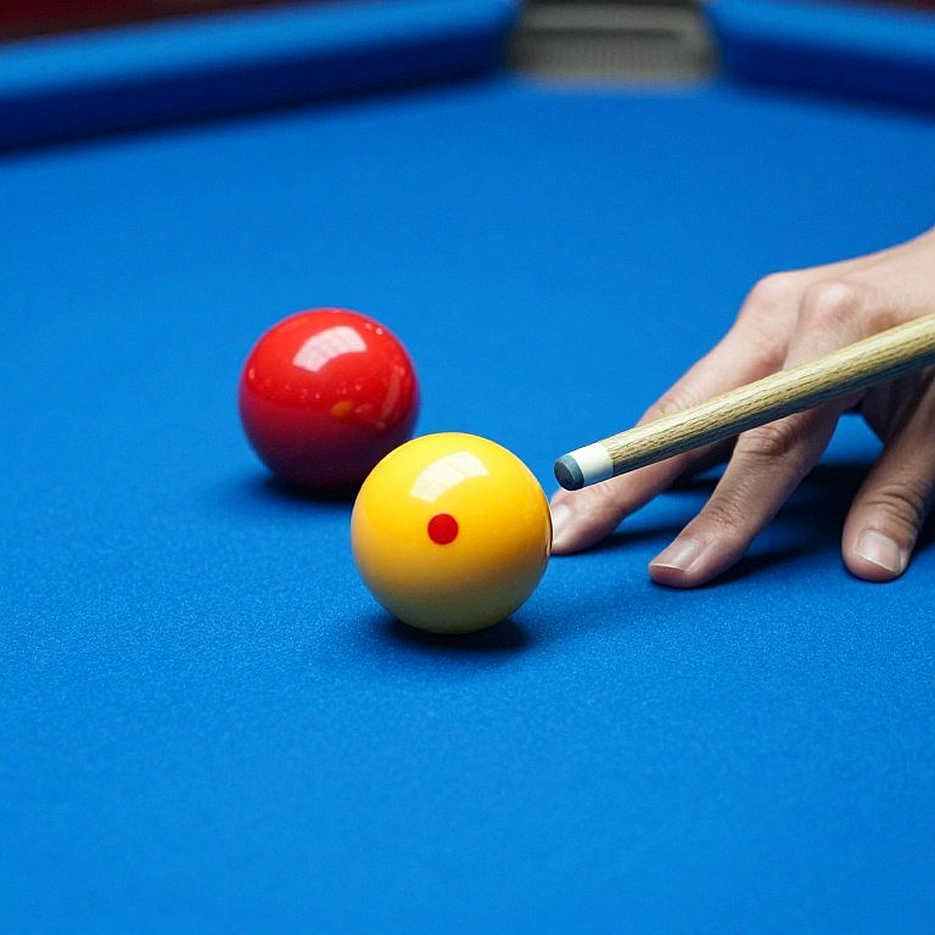
In billiards, chalk is not decoration. It is a microscopic layer between the tip and the cue ball surface, generating the friction needed to transmit spin. A clean tip striking a chalked cue ball produces considerably more spin than a bare one. That is why every player chalks before every shot, and why chalk manufacturers compete on three parameters: particle fineness, grip, and excess dust.
Turning Point rose over recent years largely on the back of its darker-toned chalk. The black chalk Shaw referenced in his post has a pronounced tendency to leave marks on the surface of the white ball. On a white ball, everything shows. A green chalk smudge might have been ignored. A black one will not.
I need to be explicit about my level of certainty here: I have no laboratory, I have not measured the chemical composition of this chalk, and I have no ball samples to analyse. What I have is a repeated observation: the referee wiped the ball, and the cloth came back with a black streak. The organiser confirmed the same on the live broadcast. That is a fact verifiable with the naked eye, no laboratory required.
Da Nang, humidity, and the mechanism of chalk transfer
This is the part the online argument almost entirely skipped.
Chalk reaches the cue ball by three different routes. Direct pressure from the tip deposits a thin layer at the contact point. Airborne chalk dust settles onto the ball surface. And hands touch the ball when it is replaced.
The second route depends almost entirely on humidity and air circulation. That is an environmental variable, and it does not care which player is holding the cue.
The Peri Pool Arena on day two held roughly two hundred spectators around the playing table, and by Shaw's own account, the area had no air conditioning. With Da Nang's characteristic relative humidity, water vapour in the air settles onto the white ball and forms a microscopic film. Airborne chalk dust — generated by both players' own chalking — has somewhere to land.
I want to place three facts side by side here, transparently, adding nothing:
Both players chalk before every shot. The difference lies in the colour and formulation they choose.
Only one of the two players uses dark-coloured chalk.
Only the player using dark-coloured chalk is the one not complaining about marks on the ball.
That structure does not prove who is right or wrong. It says only that if the black streak on the cue ball is real, it has a clear origin, and that origin is an equipment choice rather than unsporting conduct.
The arena was not empty, but the variable still surfaced
I have a line I keep using when analysing matches: "An empty stadium, a coach's voice clearer than ever, and the data too."
Da Nang is the inverted case. The arena was not empty — it was full. It is precisely the crowd that exposed the variable, because two hundred bodies in an unconditioned space create a microclimate that an air-conditioned arena would have concealed completely. The same chalk, the same player, placed in a temperature-controlled indoor venue, might never have produced a chalkgate at all.
This is the point I consider most valuable methodologically: environmental variables are usually invisible under controlled conditions, and become visible when control disappears. No laboratory needed. Only an afternoon with the air conditioning switched off.
The wiping ritual and the gap in the rules
Under WNT and WPA playing regulations, a player has the right to ask the referee to clean the cue ball. It is a legitimate, common right, designed to protect the fairness of the match: a dirty ball rolls differently from a clean one, and nobody should lose because of a chalk smudge.
The issue lies in frequency and in timing.
I logged the wipe requests during the session. Most landed at the exact moment Duong Quoc Hoang had just finished his visit and was leaving the table. That is the most sensitive moment in a rack. The player leaving the table usually carries momentum with him. The player arriving needs to rebuild his picture of the layout before the first shot.
The current rulebook sets no limit on the number of ball cleanings in a match. Nor does it specify a minimum interval between requests. That is a real gap, and every player at this level knows it exists.
Put another way: what Shaw did is legal. The fact that it unsettles his opponent is also legal. Those two statements do not contradict each other, and it is precisely that lack of contradiction that makes it worth discussing.
The twelve-rack run and the anatomy of a comeback
Back to the raw match data, because it needs to sit beside the chalk story rather than be buried by it.
On day two, Jayson Shaw at one point trailed by as many as 12 racks. He closed that gap, then caught fire midway through the session with a run of roughly twelve consecutive racks to level at 45-45. In a race to 120, a 12-rack deficit at the midpoint is not destiny: the structure of the format allows a long winning run to flatten almost any margin, provided the player holds his rhythm.
"A team's journey is not an upward arrow, it is a scatter plot." Swap the team for a cueist and the line holds exactly. The 60-56 scoreline after day two is not a straight line. It is the final output of dozens of small oscillations, and most of them have nothing to do with chalk.
Then Duong Quoc Hoang won the closing stretch of the session and closed the day at 60-56. A four-rack gap in a 120-rack match is noise. It sits within a margin that a lucky two-rack swing can erase inside fifteen minutes.
Did chalkgate work? Three explanations
The most popular hypothesis online is the sharking hypothesis: Shaw requested wipe after wipe to break his opponent's rhythm. That is a plausible hypothesis about match psychology, and it deserves testing with data rather than with feeling.
If I plot the wipe requests on the same timeline as the score, the pattern runs in the opposite direction to the sharking hypothesis. The densest cluster of wipes fell during the stretch when Shaw was trailing and needed to rebuild the match for himself. He won most of the racks that followed those wipes, not the ones before them. But this is an observation from a single session, on a small sample, and I will not use it to draw a conclusion.
The medal is not on the scoreboard, it is in the xG table. For billiards, the equivalent of an xG table is a log of every occasion a referee touched the cue ball — something nobody records, and precisely because nobody records it, nobody can verify it.
The second explanation returns to the environment. In an unconditioned arena holding two hundred people, the mechanism of chalk dust adhering to a ball under the influence of moisture operates with any chalk. Black chalk merely makes that mechanism visible. Visible is not the same as more. A green chalk smudge on the white ball may have been there for years without anyone ever calling for a wipe because of it.
The third explanation concerns Shaw himself. He is a fast player, and long interruptions hurt fast players more than slow ones. If that holds, the wiping ritual he initiated is actually a self-imposed pacing mechanism — a way of forcing himself to slow down mid-run. The same behaviour, read two entirely opposite ways.
The three explanations are not mutually exclusive. What I refuse to do is pick one and call it a conclusion when the data sample consists of a single session.
What to watch on day three
Day three runs to the 90-rack milestone. There are three signals I will be logging.
Wipe-request frequency, normalised per rack. An absolute number is meaningless; a ratio is not.
Whether the organiser addresses ventilation. If the arena is improved and wipe frequency falls in parallel, then the environment is the real variable, not the chalk brand.
And finally, the structural pressure on Duong Quoc Hoang himself. He cannot switch chalk mid-showmatch without creating an entirely different story, because he is bound by an ambassadorship contract. A commercial choice has walked onto the table and become part of the tactics. That is something no cueist can solve simply by playing better.
Market and sport are growing ever harder to separate. A black chalk streak on a white ball is where the two meet, and the referee is the only person standing between them.
Data limitations
The sample for this analysis is one session of one showmatch at one venue. Sample size: one. Any conclusion drawn from it is directional, not statistical.
Wipe-request frequencies were logged by hand while watching, not taken from official organiser data. Error is unavoidable.
I did not test the composition of the chalk in question and have no basis to assert anything about its formulation beyond what the manufacturer and users have published.
Information on Duong Quoc Hoang's brand ambassador role from 2026 onwards is drawn from public brand announcements and his sustained use across WNT and WPA events.
The entire analysis of humidity and chalk adhesion is inferred from basic surface physics, not from a controlled experiment. Correlation is not causation, and in this case I do not yet have enough data to establish even correlation.