
Trang chủTable TennisThree Seconds Before the Ball Bounces: Where World Table Tennis Is Truly Decided
Three Seconds Before the Ball Bounces: Where World Table Tennis Is Truly Decided
In the early hours of August 4, 2026, on table one of the Paris Sud arena,...
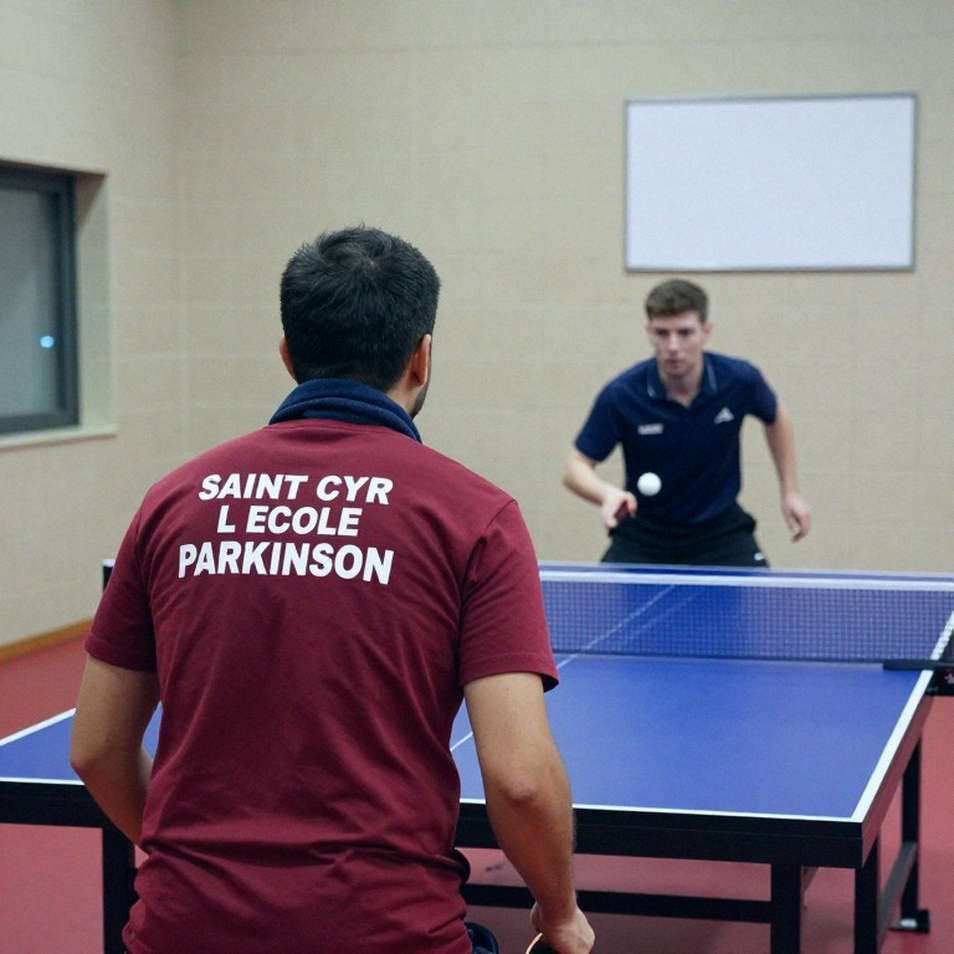
In the early hours of August 4, 2026, on table one of the Paris Sud arena, Truls Moregard bent low and sent down a sidespin serve. The ball curved over the net and clipped the left edge. Fan Zhendong was already standing there. He did not guess the direction of the ball. He read it.
In the roughly three seconds between the ball leaving his opponent's racket and its first bounce, Fan completed his decision: a half-step of the left foot to the side, a drop of the right shoulder, and a backhand ripped straight down the diagonal. Moregard only managed to turn his hips. The ball passed, and the score moved to 9-7 in favor of the Chinese player.
I have rewatched that frame seventeen times. Not to count points. I slowed it down to find what sits between two touches of the ball — the silence in which every elite table tennis match has already been decided before the crowd can cheer.
Others see the rally; I see the decision that was made three seconds earlier.
Table tennis is the most misread sport among the combat disciplines. Most spectators see only the ball: the speed, the spin, the blazing counter-loops on both sides of the table. They cheer when the ball lands on the opponent's side and groan when it flies past the edge. But the decisive part of the match lies in the stretch before the ball first bounces on the receiver's side — the stretch that cameras skip and commentators gloss over.
To understand why one table tennis nation dominates the world, you have to understand the structure of those three seconds. The Paris 2026 men's singles final is an ideal cross-section: on one side, the Chinese system forged from childhood inside the machinery of a national sports apparatus; on the other, a Swedish player with a strange hexagonal racket and an improvisational game. The result tilted toward the system, but how it tilted is what matters.
A few milestones are needed to understand the physical context of this sport. In 2026, the International Table Tennis Federation increased the ball diameter from 38 millimeters to 40 millimeters. In 2026, the celluloid ball was replaced by the 40-millimeter-plus plastic ball. Both changes moved in the same direction: less spin, less ball speed, longer rallies. Each time the ball changed, the entire world ranking was shuffled within two to three years.
Alongside the ball, the racket changed too. Rubbers and blades were once a materials arms race, until the ban on speed glue forced manufacturers toward technology built into the rubber itself. The result is that today, the difference between elite players lies mainly no longer in the equipment, but in how they use it.
In 2026, the professional tour was restructured into World Table Tennis, with Grand Smash, Champions and Contender events spread across the calendar. Players no longer contest just a few continental and world championships each year; they chase a dense schedule around the planet. Physical pressure and ranking-point pressure rose, and the gap between the top players was compressed.
At Paris 2026, China took all five gold medals: men's singles, women's singles, men's doubles, women's doubles and mixed doubles. Reading the medal table, the story seems simple. But reading each rally, the story is far more complex. The mixed doubles bronze of Lim Jong-hoon and Shin Yu-bin for South Korea, and the moment they shared the podium with the North Korean pair, showed that the rest of the world is not standing still.
Back to Fan Zhendong's frame. Those three seconds are in fact three consecutive decisions, each lasting less than a second.
The first decision is reading the spin. Moregard's serve carried sidespin combined with topspin, with the ball drifting toward Fan's backhand side. During the time the ball travels over the net, Fan must classify the spin type, estimate the length, and locate the bounce point. An amateur sees the ball. An elite player sees the ball's code.
The second decision is choosing where to stand. Fan does not stand in the middle of the table. He stands about a hand's width toward the backhand side, leaving room for the forehand if the ball goes cross-court. This is the point I always note when reviewing footage: the stance before receiving a serve reveals almost the entire tactical intent of the player in that rally.
The third decision is choosing the return shot. Fan chooses the backhand ripped down the diagonal rather than the forehand. He changes the ball's direction and the rhythm at the same time, so Moregard cannot re-establish his stance. In table tennis, this is called the opening shot — the shot that opens up the attacking phase for the player himself.
Three decisions, three seconds. Every pattern begins from a gap that someone forgot.
There is a small detail in the frame I want to linger on longer: the contact point. Fan contacts the ball at the highest point of its arc, just before it begins to drop. That contact point gives him the most options in direction and power. If he let the ball drop lower, he would be forced to lift it and lose the initiative. The entire advantage of the rally comes from half a hand's width of timing difference.
This is why I say table tennis is a sport of small distances. Half a hand's width of offset stance, one hundredth of a second of earlier contact, a touch more spin — added together, they produce an eleven-point margin on the scoreboard.
In table tennis, there is an area called the elbow — the junction between a player's forehand reach and backhand reach. Hitting the ball into that exact area forces the opponent to choose between two shots and lose a fraction of a second in hesitation. Most opening shots at the elite level aim at this area, not at the far corner.
Spectators do not see this. They see the ball land in the middle of the table and think it is a safe shot. But to those in the trade, a ball into the middle at a certain moment is the most uncomfortable shot of all. Once again, the forgotten gap sits right in the center, where every eye passes over it.
In the short-serve phase, the battle takes place within twenty centimeters around the net. The server tries to make the ball bounce twice on the opponent's side to limit the attack. The receiver must choose between a short push, an attacking flick, or a spinning chop. Each choice opens a different branch of the match, and a mistake here usually means losing the point immediately.
What makes Chinese table tennis different does not lie in one specific player. Ma Long, Fan Zhendong, Wang Chuqin, Sun Yingsha, Chen Meng — they are different names, but they step out of the same training machine, identical in principle.
That machine has three tiers. The first is the system of sports schools and local training centers, where children are selected from the age of six or seven and drilled in footwork and reflexes. The second is the provincial and national teams, where each player is matched with a group of training partners who simulate the exact playing style of international opponents. The third is the national team, where analysts reconstruct each opponent into a detailed file.
The second tier is the least mentioned and also the strongest. In training sessions in China, a lead player may rally for days on end with partners simulating the very style of the opponent he is about to face. Before a major event, they have met the opponent hundreds of times in the training hall before meeting them for real at the competition table. The distance between training and competition is almost erased.
Others see a genius player; I see a system that has already prepared answers to nearly every question an opponent can pose.
But that system has its price. Training based on opponent simulation assumes the opponent will behave exactly as predicted. When a stranger appears with a style that has no precedent, the system needs time to update. That window of time is precisely the opportunity for the rest of the world.
The rest of the world refuses to stand still, and how it responds is the most interesting part of the picture.
Sweden chose the opposite path: maximum individualization. Truls Moregard is the emblem of this direction. His hexagonal racket is not merely a curiosity; it changes the contact point of the ball on the racket face, opening angles that a traditional round racket struggles to create. Moregard plays on instinct, relying on feel and improvisation rather than templates. He reached the world championship final in 2026 at just nineteen, a milestone showing that an unconventional game still has room to live.
Japan chose the path of systematization, but in its own way. Tomokazu Harimoto rose very early with a speed-based game, close to the table, rarely retreating. Japan invests in sports science and data analysis, trying to close the gap through technology rather than through sheer numbers of trainees.
South Korea chose a balanced path. The Korean table tennis tradition is tied to a powerful forehand game and a tenacious competitive spirit, marked by Ryu Seung-min's men's singles gold at Athens 2026 — the last time a non-Chinese player won Olympic men's singles. The current generation, with Shin Yu-bin on the women's side and young players on the men's side, is trying to combine a solid technical base with the ability to adapt quickly against other Asian opponents.
I live in Busan, a city with a long table tennis tradition and a fan community that follows the sport far more seriously than most people imagine. On evenings at the table tennis clubs around the city, I often sit and watch amateurs play each other for hours. They do not know that they are reproducing exactly the principles that the world's top players apply, only at a speed several times slower.
Once, at an open training session in Busan, I stood outside watching a coach teach a student how to receive a sidespin serve. He did not explain in words. He simply tossed the ball again and again, hundreds of times, and let the student adjust on his own. After the session, he told me something I have never forgotten: the ball does not lie. Only the reader misreads it. That sentence sums up my entire method.
There is a paradox I have observed across many seasons. When material runs dry, people finally see clearly what truly sustains tactics: ideas.
World table tennis is at a stage where the material factor is nearly uniform. The 40-plus plastic ball is produced to a common standard, rubbers and blades are all purchasable, and training centers in Europe and Asia all have access to modern sports science. The equipment gap is nearly zero. So what creates the remaining gap?
The answer lies in foundational thinking: how a table tennis nation defines what a good rally is. In China, a good rally is a controlled rally. In Sweden, a good rally is a rally that creates surprise. Those two definitions lead to two completely different training systems, and the results at the competition table are a by-product of them.
What makes a system outlast time is not its titles, but the structure it leaves behind.
At this point I must argue against myself, because it is the part I always deliberately write out even when it is uncomfortable.
The way I analyze — dissecting each frame, counting opening shots, reconstructing stances — has an inherent blind spot. When I split a rally into three decisions, I am assuming the player also thinks in those three steps. But most decisions at the elite level occur below the threshold of consciousness. Fan Zhendong does not calculate in three steps; he reacts based on thousands of hours of training that have turned analysis into instinct.
In other words, the analyst himself may be reading speed into something that does not operate at that speed. This is the risk of an entire industry of sports data analysis: conclusions drawn from data may detach from the true rhythm of competition. I have many times had to delete passages that sounded very logical but did not match the player's own feeling when I asked him afterward.
The greatest defeat does not come from a mistake, but from believing one cannot be wrong. That is true of the player, and equally true of the person sitting outside the table analyzing him.
If I am wrong about Fan Zhendong, the alternative hypothesis would be: his success comes from trained instinct, not from calculation. And if so, all the charts I build describe only the surface of something much deeper.
There is a habit I have kept for many years: rewatching old matches, not finals, but forgotten group-stage games. I learn more from one low-attendance qualifier than from ten finals dressed up by the media. In those matches, the players play more honestly, with less calculation, and the tactical holes show more clearly.
From those frames, I drew one thing about Chinese table tennis that the medal table cannot say. Their strength does not lie in having the best player, but in having so many players nearly equally good that the internal national squad becomes the harshest tournament on the planet. The winner of the internal selection trial has sometimes overcome a challenge harder than a world final.
The annual season with its dense WTT schedule will be a test of stamina and mentality, not only technique. The first indicator I watch is the number of successful opening shots by top players in the fourth and fifth games of long matches. This indicator reveals the fitness system and the ability to maintain technical structure under fatigue.
Alongside that, I track the win rate of European players against Asian opponents in early-round matches, where the schedule and time zones create a disadvantage. This indicator reveals adaptability, traditionally the weak point of systems that rely heavily on preparation.
What I watch no less is how teams manage the rotation of players between events to preserve fitness for the majors. This is where coaching strategy is exposed most clearly.
After every major match, the media chases the winner. I understand why. But after I turn off the screen, what stays with me is not the name on the podium, but the gap both players overlooked together — a corner of the table no one covered, a rhythm no one changed, a decision postponed by half a second.
That is why I stay behind after every match, slow it down, and take notes. Not to find a hero. But to find structure. Because titles fade, while structure remains, and structure is the only thing a table tennis nation can pass on to the next generation.
The question I leave for myself, and for those who follow this sport: if tomorrow a non-Chinese player becomes world champion, is that a sign the Chinese system is weakening, or simply a forgotten gap that someone finally filled in time?

Cầu thủ liên quan
Bài nổi bật
Deep Table Tennis Analysis: When Input Data Is Empty and Lessons for Sports Analysis Pipelines2026-10-15
Deep Table Tennis Analysis: When Input Data Is Empty and Lessons on Sports Analysis Pipeline2026-10-15
ETTU Overhauls European Youth Table Tennis: 15 Games Per Team Tie, Singles Cut to Best-of-Five2026-10-14
Vietnamese Table Tennis: The Rhythm of Young Hands and the Pipeline Problem2026-10-13
Vietnamese Table Tennis 2026: The Season Nobody Counted2026-10-09
2026 JOOLA Europe Youth Series Czech Open in Pilsen: Junior seeds, JOOLA sponsorship, and the junior-to-senior conversion puzzle2026-10-08
When Table Tennis Has No Score: The China-EU Friendship Event in Brussels and the Institutional Layer2026-09-28
Bài đề xuất
Cleveland Cadet & Junior 4* 2026: Inside England's Junior Pathway to the Nationals2026-09-25
U21 Champions at Belgium Open 2026: LAINE and PINTO Lift Portugal, but the Senior Ceiling Remains2026-09-20
When the Tactics Board Is Blank: The Analyst's Discipline of Silence2026-09-28
Dissecting the Match's Bloodstream: What Does Vietnamese Table Tennis Lack to Read an Opponent?2026-09-16
2026 JOOLA Europe Youth Series Czech Open in Pilsen: Junior seeds, JOOLA sponsorship, and the junior-to-senior conversion puzzle2026-10-08
The Trust Gap in Modern Table Tennis2026-09-20
Cleveland Cadet & Junior 4* 2026: Draw Sheets, Pathways and the Girls Nobody Has Named Yet2026-09-25
Bài đề xuất
Inside the U15 Pitch: 44 Key Passes and Everything the Scoresheet Leaves Behind2026-09-22
Table Tennis and the Lesson of an Empty Data Table2026-10-14
ETTU Overhauls European Youth Table Tennis: 15 Games Per Team Tie, Singles Cut to Best-of-Five2026-10-14
The Blank Scoreboard of Vietnamese Table Tennis2026-09-16
England Table Tennis Expands DiSE Pipeline to 36 Athletes: Lessons Vietnam Is Letting Slip By2026-09-16
Women's Table Tennis and the Verification Filter: Lessons from an Empty Data File2026-09-17
Worthing TTC launches Junior Team 1 Star: when team table tennis fills the gap at the base of England's pyramid2026-09-18
Bài đề xuất
U21 Champions at Belgium Open 2026: LAINE and PINTO Lift Portugal, but the Senior Ceiling Remains2026-09-20
Worthing TTC and Junior Team 1 Star: The Forgotten Stratum Beneath England's Youth Table Tennis Pyramid2026-09-18
Vietnam's 2026 table tennis season: the year with no scorebook2026-09-16
ETTU Europe Cup 2026/27 Draw Completed: The Draw Is Noise, the Roster Registration Window Is the Signal2026-09-18
The 0.4 Seconds No Camera Captures: Where the Tactical Map of Modern Table Tennis Actually Lies2026-09-16
The Butterfly Table, the Membership Funnel, and the London 2026 Signal Inside Table Tennis England's Community Programme2026-10-08
Vietnamese Table Tennis: The Rhythm of Young Hands and the Pipeline Problem2026-10-13